
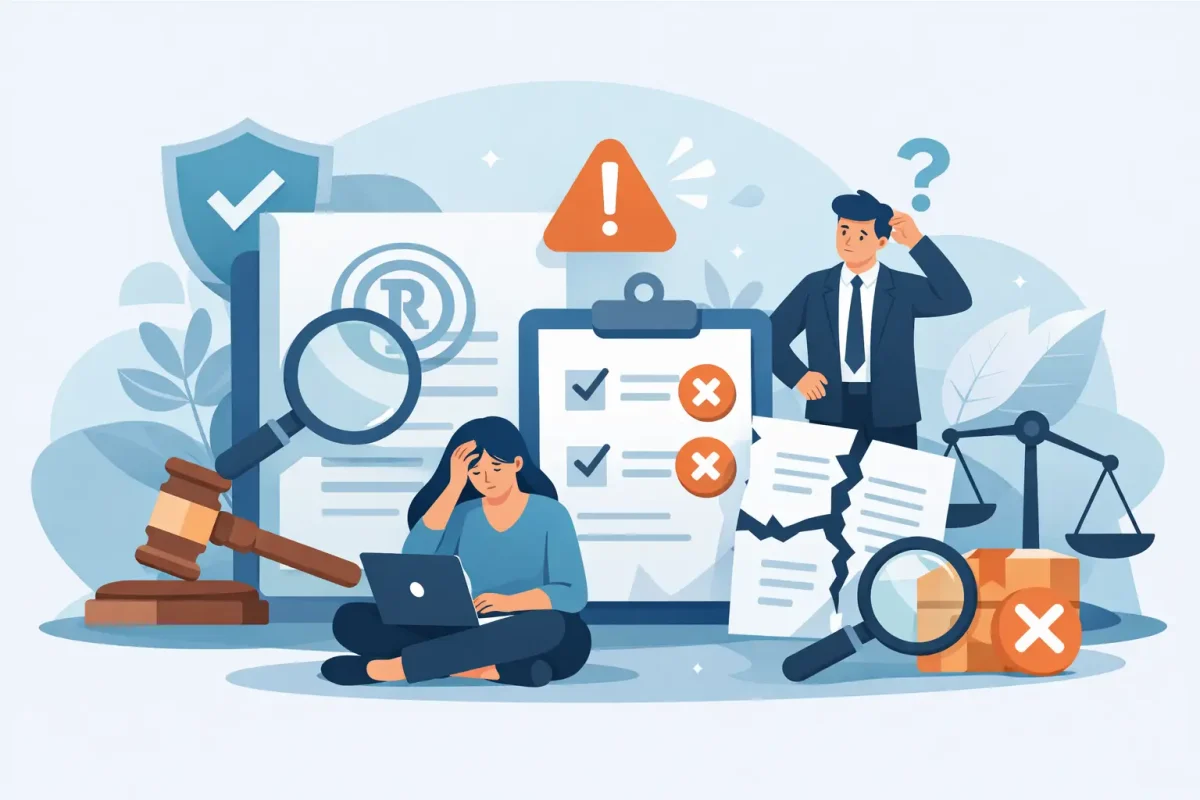
A business can spend months building a name, designing a logo, and winning customers, only to hit a serious problem when the trademark application goes in. The top mistakes in trademark filing usually are not dramatic. They are small decisions made too early, too quickly, or without enough legal review – and they can lead to refusals, delays, added cost, or weaker protection than expected.
For founders and business owners, that is the real issue. Trademark filing is not just a form to submit. It is a legal process that defines what you are protecting, how broadly you can protect it, and whether the USPTO sees your mark as registrable in the first place. A filing that looks simple on the surface can carry long-term business consequences.
Why the top mistakes in trademark filing happen
Most filing errors come from a reasonable assumption: if you know your brand, you can probably file your own application. Sometimes that works. Often, though, the risk is not in filling out the form itself. The risk is in making legal judgment calls without realizing you are making them.
Choosing the wrong owner, describing goods too narrowly or too broadly, selecting an unsupported filing basis, or overlooking a conflicting mark can all create problems that are harder to fix later. Some issues can be corrected. Others can force a refile or leave the business with a registration that does not meaningfully protect the brand.
Mistake #1: Skipping a serious trademark search
One of the most common filing mistakes is assuming that a quick online search is enough. A business owner checks Google, sees the domain is available, looks at social media, and assumes the name is clear. That is not how trademark clearance works.
A proper search needs to account for more than exact matches. Similar spelling, similar pronunciation, related goods or services, and existing federal applications can all matter. The USPTO does not require identical marks to issue a refusal. If consumers are likely to be confused, that can be enough.
This is where many applicants lose time and money. They invest in branding first and evaluate legal risk second. By then, a conflict may already be built into packaging, ads, labels, and customer recognition.
Mistake #2: Filing a mark that is too descriptive
A name can be great for marketing and still be weak for trademark purposes. This catches many businesses off guard. They choose a term that tells customers exactly what the product or service is, then assume that clarity makes it easier to register.
Often, the opposite is true. Descriptive marks face more resistance because trademark law generally does not allow one business to lock up common descriptive wording that others may need to use. A mark that merely describes ingredients, quality, function, or purpose may be refused.
There is a practical business trade-off here. A descriptive name can help customers understand what you sell. But it usually gives you less legal strength. More distinctive marks are often easier to protect and enforce.
Mistake #3: Naming the wrong owner on the application
This is a technical issue with very real consequences. The owner listed on a trademark application must be the correct legal party as of the filing date. That could be an individual or a company, depending on who actually controls and uses the mark.
Founders often file under their own names when the business should own the mark. In other cases, they file in the company name before the company is properly formed or before ownership is clear. If the wrong owner is named at filing, the problem may not be fixable with a simple update.
That matters because the filing date is valuable. If the application is invalid from the start, the business can lose priority and may need to start over.
Mistake #4: Choosing the wrong goods and services
Trademark rights are tied to specific goods and services. This part of the application is not filler. It defines the scope of the protection you are seeking.
Some applicants choose language that is too vague and triggers objections. Others choose descriptions that are too narrow, leaving important parts of the business outside the application. Another common problem is selecting goods or services the business does not actually offer yet, or classifying them incorrectly.
There is no one-size-fits-all answer here. A software company, apparel brand, consultant, and e-commerce seller each need a different strategy. The right identification should match current use or planned use while still supporting future growth where possible.
Mistake #5: Filing under the wrong basis
Applicants generally file based on current use in commerce or a genuine intent to use the mark in commerce. The distinction matters. Filing as if a mark is already in use when the use is not legally sufficient can create serious problems.
For example, reserving a name, registering a domain, or printing internal materials usually is not enough by itself. The USPTO looks for actual trademark use tied to the goods or services listed. If the filing basis is wrong, the application can face refusal or later vulnerability.
This is another area where people underestimate the legal standard. They know the brand is real and the business is moving forward, but the USPTO asks a narrower question: is there qualifying use, and can it be shown properly?
Mistake #6: Submitting weak or improper specimens
When an application requires proof of use, the specimen matters. A specimen is not just any image with the brand name on it. It must show the mark used in a way the USPTO accepts for the goods or services claimed.
This is where applicants often submit mockups, digitally altered images, ornamental use, or materials that do not function as trademark use. For goods, the mark generally needs to appear on the product, packaging, label, or point-of-sale display. For services, the specimen must usually show the mark used in advertising or marketing tied to the actual services.
A weak specimen can delay the application and raise bigger questions about whether the mark is truly in use.
Mistake #7: Treating the USPTO as a filing portal instead of a legal review process
Many applicants assume that if they submit the form and pay the fee, registration is mostly administrative. It is not. The USPTO examines applications for legal defects, conflicts, descriptiveness issues, specimen problems, classification errors, and more.
That means the application needs to be built with examination in mind. Filing quickly is not always filing well. A rushed application can create an office action that costs more time and money than careful planning would have.
This is one of the main differences between document submission and legal strategy. The application should be prepared to withstand review, not just to be accepted for processing.
Mistake #8: Ignoring office actions or deadlines
Even strong applications can receive office actions. The problem is not receiving one. The problem is underestimating it or missing the deadline to respond.
Some office actions are straightforward and fixable. Others require legal analysis, argument, and a clear understanding of how the USPTO applies trademark rules. A weak response can fail to solve the issue. No response at all can abandon the application.
The same is true after registration. Trademark protection is not set-and-forget. Required filings and deadlines continue after the registration issues.
How to avoid the top mistakes in trademark filing
The best way to avoid these problems is to treat trademark filing as a business protection decision, not just a paperwork task. That starts with asking the right questions before filing: Is the mark actually clear? Is it distinctive enough? Who should own it? What goods or services should be covered? Is the filing basis supported? Can the use be documented properly?
For some businesses, the answers are straightforward. For others, there are judgment calls. A new brand may need a broader clearance review. A growing company may need to think carefully about future expansion. An online seller may need help matching real-world sales activity to USPTO standards. That is why attorney review can make a measurable difference.
A law firm like MyBrandMark helps reduce avoidable filing risk because the process is handled as legal protection, not clerical submission. That distinction matters most when the brand is valuable enough that a mistake would be expensive.
The cost of filing incorrectly is usually not just the filing fee. It can include delay, rebranding, a narrower registration, or a conflict that should have been identified before launch. If your trademark matters to your business, the filing strategy should reflect that from the start.
A careful application does more than improve the odds of approval. It puts your brand in a stronger position when the business grows, competitors appear, and the name you built becomes an asset worth defending.